Electronic Health Record and Interoperability in Mexican Healthcare: An Infrastructure Under Construction
What the Electronic Health Record is, what NOM-024 and the 2026 decree establish, how HL7 FHIR interoperability is advancing in Mexico, and what can be built from IMSS and COSADIM.
Why the medical record matters as much as the medication
Every time a patient crosses from one health institution to another: from IMSS to ISSSTE, from a public hospital to a private clinic, from a Ministry of Health center to a third-level hospital, they carry something invisible but decisive: the story of their body. If that story does not travel, the doctor receiving it works in darkness. They prescribe without knowing what has already been prescribed; they order labs that have already been taken; they ignore allergies that another record registered.
The question that organizes digital health policy in Mexico is not, in essence, technological. It is one of governance: to whom does clinical information belong, who is responsible for making it available where it is needed, and under what rules is patient privacy protected.
What the Electronic Health Record is
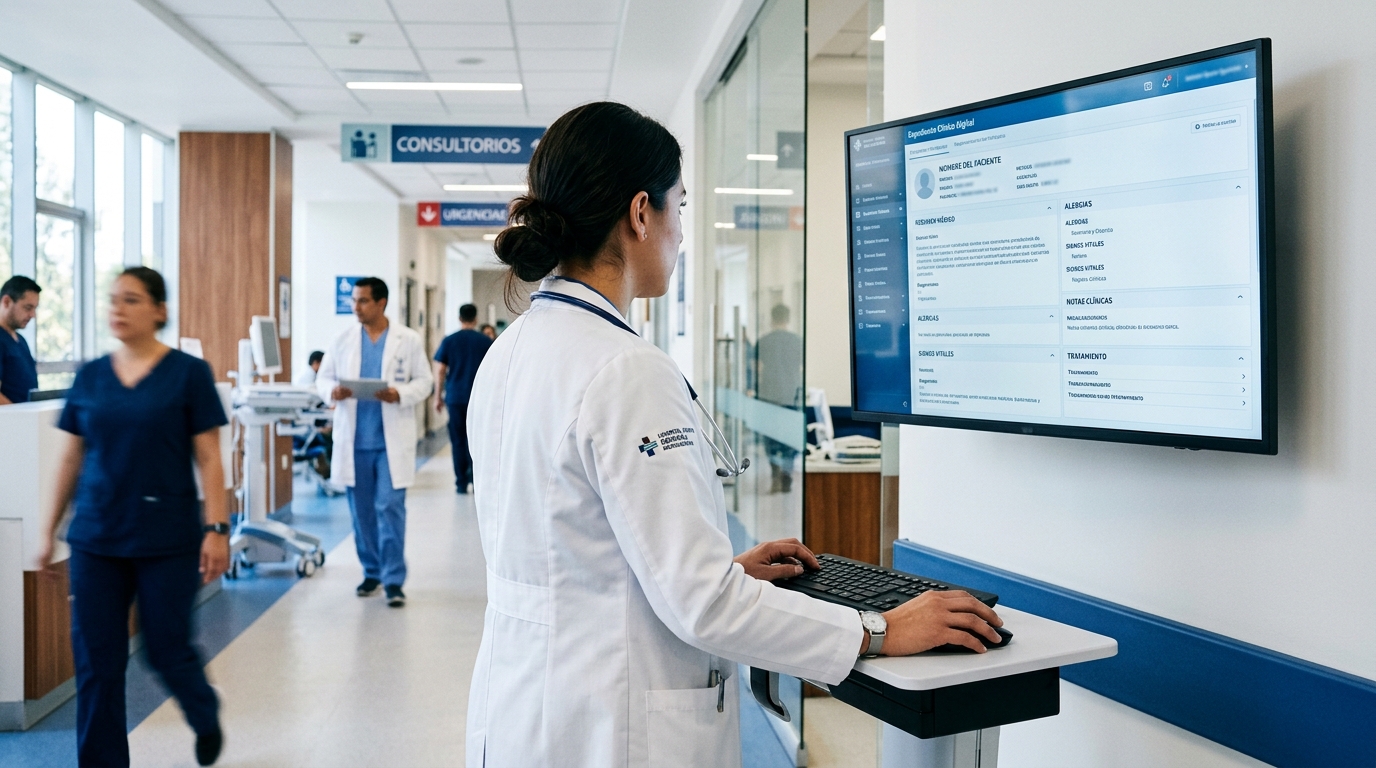
The Electronic Health Record (EHR) is the digital version of a patient's medical record: consultations, diagnoses, treatments, laboratory results, medications, allergies, vaccines, and any other data relevant to their care. In its most basic form, it replaces paper. In its most ambitious form, it is an interoperable platform that allows any health services provider to access the complete history in real time, with patient authorization.
The NOM-024-SSA3-2012: Electronic Health Record Information Systems is the current regulatory framework that establishes the functional, technical, and security requirements that electronic health record information systems must meet. It defines the minimum data an EHR must contain, the applicable coding standards (HL7, SNOMED CT, among others), and the mechanisms for exchanging information between institutions.
The standard was published in 2012 and has spent more than a decade guiding the digitalization of Mexico's health sector. Its application has been uneven: the large institutions of the social security system advanced in adopting proprietary systems, but interoperability among them (which is the real objective of the policy) lagged. The reason is not technical. It is organizational: each institution digitalized inward, without sufficient incentive to connect outward.
The 2026 legal framework: an inflection point
The Decree amending, adding to, and repealing various provisions of the General Health Law, published on January 15, 2026, establishes provisions that reinforce the mandatory nature of the EHR for both the public and private sectors, and enables the construction of a universal record that transcends institutional boundaries. It is the legal instrument that turns what was previously a normative aspiration into an obligation with legal basis.
This legislative move comes in a context in which IMSS had already identified its own platform as the logical starting point for scaling toward a national system. Zoé Robledo, general director of IMSS, stated that the 'IMSS Electronic Health Record will be the origin for building a universal system that safeguards the medical history of the entire population'. The statement signals a clear strategic direction: instead of building a new infrastructure from scratch, scale the existing one to the rest of the health system.
An additional element of the panorama is the single health credential with an integrated electronic record. According to information available on the launch of the single health credential, Mexico has advanced on an instrument that links the citizen's identity with their digital medical history, which partially resolves one of the underlying problems: knowing with certainty to whom each record corresponds in a system with multiple parallel registries.
The interoperability gap
Having an EHR in each institution is not equivalent to having an integrated digital health system. The decisive step is interoperability: the capacity for different systems to exchange information in a way that is understandable to all parties involved. An EHR at IMSS and one at ISSSTE that do not communicate with each other are, in practice, two separate silos. Duplication of studies, loss of history, and errors derived from incomplete information persist.
An analysis published in Salud Pública de México on the state of ICT in the public sector of Mexico's Health System documents that the main barriers are not technical but rather institutional coordination and governance: different institutions with different systems, different diagnostic catalogs, and different budget priorities. The systems exist; the problem is that they do not converse.
The international standard that has gained the most traction to solve this problem is HL7 FHIR (Fast Healthcare Interoperability Resources). FHIR allows the exchange of clinical data through web APIs, so that each institution can maintain its internal system while exposing data in a universal format. The analysis on the state of adoption of the HL7/FHIR standard in Mexico shows that some large institutions have started pilot projects with this standard, but the bulk of first-level providers remains outside it.
Coding catalogs represent a second layer of the problem. SNOMED CT (Systematized Nomenclature of Medicine Clinical Terms) allows diagnoses, procedures, and clinical findings to be described with a precision that eliminates ambiguities between systems. Its adoption in Mexico is incipient and requires not only the acquisition of licenses but also the training of clinicians and engineers capable of operating with the terminology in real care contexts.
COSADIM and the architecture of digital governance
Mexico's institutional response to the need for coordination is expressed in COSADIM (Mexico's Digital Health Committee), an instance that brings together different institutions in the sector to agree on standards and digitalization priorities. According to the analysis published by GS1 México on digital health in Mexico, interoperability, and COSADIM, the committee has advanced in defining a roadmap that includes the adoption of HL7 FHIR as the exchange standard and the harmonization of catalogs between institutions.
COSADIM operates at a complex intersection: it needs to generate agreements among actors with different organizational cultures, asymmetric budgets, and incentives that do not always converge. The private sector has technological investment capacity but scarce incentives to open its systems to interoperability, which can be perceived as a loss of competitive advantage. The public sector has a legal mandate but faces budgetary restrictions and a shortage of personnel specialized in digital health.
The architecture Mexico needs is not a single, centralized system (a model that presents its own risks of concentration and dependence on a single provider) but a federation of systems that share data under common protocols. The FHIR model points precisely to that: each institution maintains its system, but all speak the same language when exchanging clinical information.
The international reference
The experience of other countries offers concrete lessons. Brazil advanced with the Rede Nacional de Dados em Saúde (RNDS), which implements HL7 FHIR as its exchange standard and has managed to connect laboratories, hospitals, and the vaccination system on a common platform. Spain consolidated the Historia Clínica Digital del Sistema Nacional de Salud (Digital Clinical History of the National Health System), which allows a doctor in Catalonia to access the history of a patient treated in Andalusia. Both cases took more than a decade to consolidate and required legal reforms, sustained investment, and a governance instance with real authority over standards.
The common denominator of the successful cases is the combination of three elements: legal mandate, autonomous technical governance, and predictable financing. None of the three is sufficient on its own. Law without governance produces obligations without compliance mechanisms. Governance without law produces recommendations that no one follows when there is a cost. Financing without a mandate produces well-equipped but disconnected islands.
What Mexico can build
The current moment offers favorable conditions for taking concrete steps. The legal reform of January 2026 provides the legal mandate. IMSS contributes the country's most mature infrastructure as a verified starting point. COSADIM has the mandate for technical governance. And the FHIR standard offers an implementation route proven in multiple international health systems.
A first concrete, high-impact step is the publication of a national FHIR profile: a set of specifications that adapt the international standard to the Mexican context, with its own catalogs (localized ICD-10, SNOMED in Spanish), national identifiers, and institutional workflows. This profile would function as the common language that all actors must speak before interoperability is technically possible at scale.
A second strategic move is the creation of an interoperability laboratory, physical or virtual, where public and private institutions can test the connection of their systems before the mandate enters into force with full consequences. Test environments reduce the cost of compliance because they make it possible to detect incompatibilities before they affect real patients.
Finally, the digital health agenda requires an explicit strategy for training specialized talent: health engineers, clinical terminologists, data managers with training in privacy and security of medical information. The technology is available; the main gap is in people who know how to operate it in the Mexican institutional context, with its legal, organizational, and budgetary particularities.
The Electronic Health Record is not an end in itself. It is the condition of possibility for a health system that learns: that can track which treatments work in which populations, anticipate epidemiological outbreaks, allocate resources where they are needed, and, ultimately, care for each patient with the complete information of their clinical history. The infrastructure has already begun to be built. The challenge now is one of standards, coordination, and sustained institutional will.
Fuentes:
- https://sidof.segob.gob.mx/notas/5778298
- https://platiica.economia.gob.mx/normalizacion/nom-024-ssa3-2012/
- https://www.imss.gob.mx/prensa/archivo/202411/067
- https://www.scielo.org.mx/scielo.php?script=sci_arttext&pid=S0188-62662020000100131
- https://saluddigital.com/big-data/estado-de-situacion-en-la-adopcion-del-estandar-hl7-fhir-en-mexico/
- https://blog.gs1mexico.org/salud-digital-mexico-cosadim-interoperabilidad
- https://u-gob.com/mexico-lanza-su-credencial-sanitaria-unica-con-expediente-electronico-integrado/
Sources
- Decreto por el que se reforman, adicionan y derogan diversas disposiciones de la Ley General de Salud (15 enero 2026)
- NOM-024-SSA3-2012: Sistemas de información de registro electrónico para la salud. Intercambio de información en salud
- Expediente Clínico Electrónico del IMSS será el origen para construir un sistema universal que resguarde el historial médico de toda la población: Zoé Robledo
- Las TIC en el sector público del Sistema de Salud de México: Avances y oportunidades
- Estado de situación en la adopción del estándar HL7/FHIR en México
- La Salud Digital en México: interoperabilidad, COSADIM y el futuro del sistema de salud
- México lanza su credencial sanitaria única con expediente electrónico integrado