World Cup 2026: The Infrastructure Showcase Accelerating Nearshoring
The 2026 World Cup leaves Mexico with mobility infrastructure and airports across three host cities. An investment and nearshoring window that extends toward 2030.
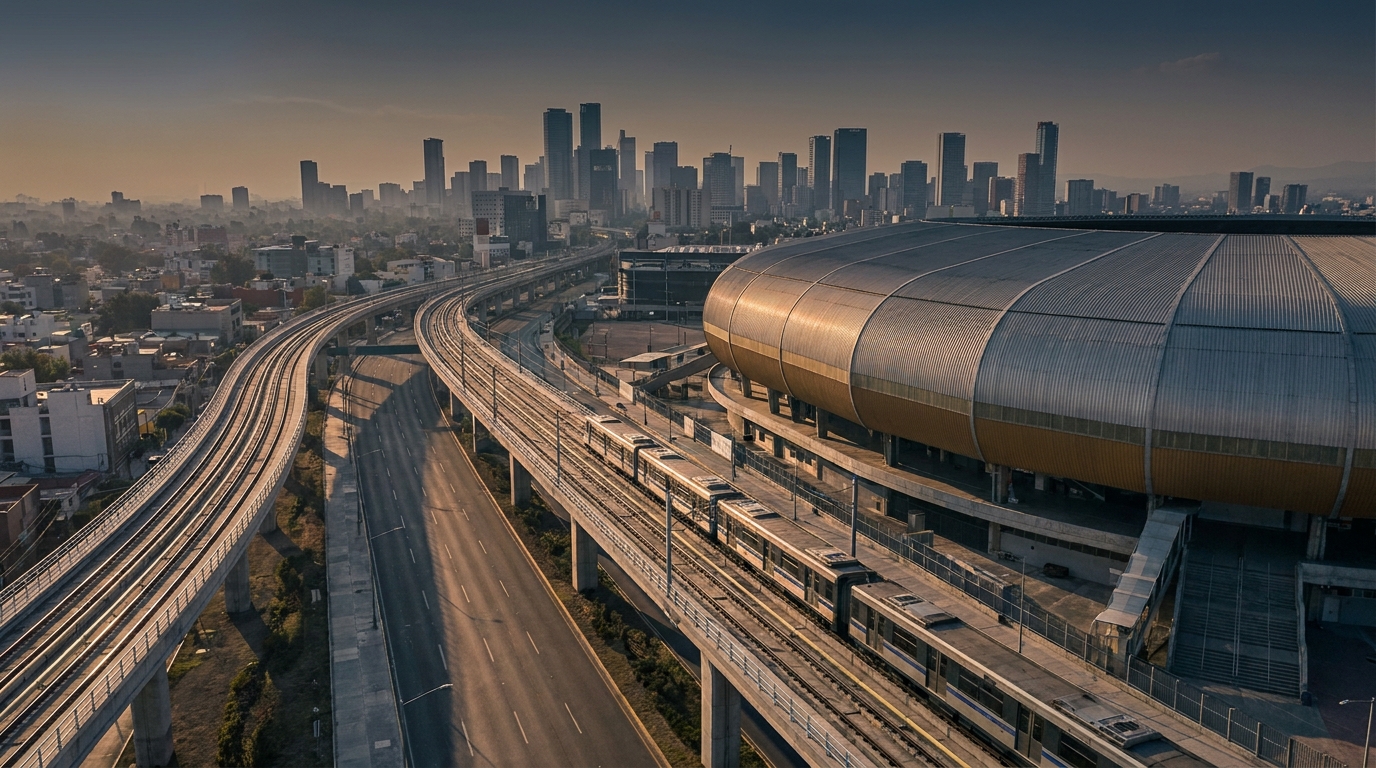
The tournament's revenue is what is visible. The permanent asset is the mobility corridors, airports, and stadiums that reposition Mexico before global capital.
Mexico hosts 13 of the 104 matches of the FIFA World Cup 2026 between June 11 and July 19, spread across Mexico City, Guadalajara, and Monterrey. The event concentrates global media attention on three of the country's most relevant industrial metropolitan areas. Behind that exposure sits a layer of infrastructure investment whose operational horizon extends far beyond the tournament's duration.
Consulting firm Deloitte estimates a total economic impact of 4,050 million dollars for Mexico, with 1,800 million in infrastructure investment and 2,730 million in value added, equivalent to 0.14 percent of GDP. The tourism consumption figure, significant in its own right, runs its course with the sporting calendar. Physical investment, by contrast, remains in place and available for economic activity over the next decade.
That is where the greatest value capture opportunity lies. Reading the World Cup as event spending underestimates its real function: an international showcase that synchronizes, within a single timeline, airport modernization, mass transit expansion, and world-class logistics standards. This alignment reinforces the nearshoring thesis already positioning Mexico as North America's industrial platform.
The Structural Opportunity: Infrastructure with Decades of Useful Life
The federal government is allocating between 1,500 and 2,000 million pesos per host state for mobility, directed at Metro Line 2 in Mexico City, Line 5 in Jalisco, and Lines 4 and 6 in Nuevo León, according to the Presidency of the Republic. Added to this are 500 million dollars in stadium renovations and more than 2,000 million in transportation and urban development, according to the U.S. Department of Commerce. These are permanent-use assets, not temporary installations.
Implications: Who Benefits and at What Scale
Mexico City International Airport is receiving 8,500 million pesos in terminal, drainage, and ventilation upgrades, while Monterrey Metro Lines 4 and 6 are at 83 percent completion, according to Infobae. For institutional investors, industry chambers, and logistics operators, this reduces supply chain friction and improves connectivity across three manufacturing hubs. Deloitte projects an additional 112,200 temporary jobs, a training base that outlasts the event. The estimated flow of five million visitors serves as a system stress test.
Implementation Roadmap: Sequence, Actors, and Timing
The sequence is already underway. Estadio Azteca's renovation concluded in May 2026 after 18 months of work, featuring a hybrid pitch and 40 kilometers of fiber optics installed, according to Infobae. Mobility corridors are operating against the tournament calendar, imposing an execution discipline rarely seen in public works. For private capital, the value capture path involves three moves: positioning in services and lodging before the June-to-July demand peak, securing operation and maintenance contracts for the new infrastructure, and mapping the logistics corridors that will be operational by 2027. The U.S. Department of Commerce identifies technology, infrastructure, and hospitality as the highest-demand sectors associated with the tournament.
Risks and Mitigation: Safeguarding the Legacy
The primary concern is service capacity. Projected lodging consumption of 614 million dollars according to Deloitte points to demand that in some host cities exceeds installed supply, opening an investment window in hospitality with returns extending beyond 2026. Mitigation requires defining post-tournament infrastructure use plans so that Metro lines and airport upgrades are integrated into long-term urban programs. Coordination across all three levels of government and the private sector determines what share of the investment converts into sustained competitiveness.
Executive Summary
The 2026 World Cup delivers Mexico two simultaneous assets: consumption revenue bounded by the tournament, and a permanent base of mobility, airport, and logistics infrastructure. The second asset is what repositions the three host cities before global capital.
Toward 2026-2030, the transport corridors and airport connectivity enabled today will form part of Mexico's investment proposition under the USMCA framework. The sporting showcase becomes an industrial platform: the physical legacy, more than the revenue, will be the metric that funds measure.
For executives and funds with Mexico exposure, this is the moment to map value capture. Subscribe to Scientika's weekly analysis or schedule a strategy session to evaluate your positioning vis-à-vis World Cup 2026 infrastructure.
Frequently Asked Questions
What is the total economic impact of the 2026 World Cup for Mexico?
According to Deloitte, cited in June 2026, the 2026 World Cup leaves Mexico an estimated total economic impact of 4,050 million dollars, comprising 1,800 million in infrastructure investment and 2,250 million in consumption, with 2,730 million in value added equivalent to 0.14 percent of GDP and 112,200 temporary jobs.
How much is the federal government investing in mobility per host city for the 2026 World Cup?
The federal government is allocating between 1,500 and 2,000 million pesos per host state, directed at Metro Line 2 in Mexico City, Line 5 in Jalisco, and Lines 4 and 6 in Nuevo León, according to the Presidency of the Republic.
How many 2026 World Cup matches are played in Mexico and in which cities?
Mexico hosts 13 of the 104 matches of the FIFA World Cup 2026, between June 11 and July 19, 2026, distributed as Mexico City with 5 matches, Monterrey with 4, and Guadalajara with 4.
Fuentes:
- Presidency of the Republic (gob.mx), Federal investment in mobility per FIFA World Cup 2026 host city: https://www.gob.mx/presidencia/prensa/anuncia-presidenta-inversion-de-2-mil-mdp-en-movilidad-para-cada-una-de-las-sedes-del-mundial-fifa-2026-cdmx-jalisco-y-nuevo-leon?idiom=es-MX
- U.S. Department of Commerce (trade.gov), Mexico World Cup 2026 Opportunities: https://www.trade.gov/market-intelligence/mexico-world-cup-2026-opportunities
- Deloitte, via CIAL Dun & Bradstreet, Economic impact of the 2026 World Cup on Mexico and LATAM: https://en.cialdnb.com/blog/economic-impact-world-cup-2026-mexico-latam
- Infobae, How Mexico prepared for the 2026 World Cup: https://www.infobae.com/mexico/deportes/2026/05/20/como-se-preparo-mexico-para-el-mundial-2026-estadios-remodelados-nuevas-obras-e-infraestructura/