Electric Justice 2026: The Last Mile as an Investment Window
The Plan de Justicia Eléctrica brings Mexico's coverage to 99.8 percent. Closing the last mile with distributed generation opens an investment window.
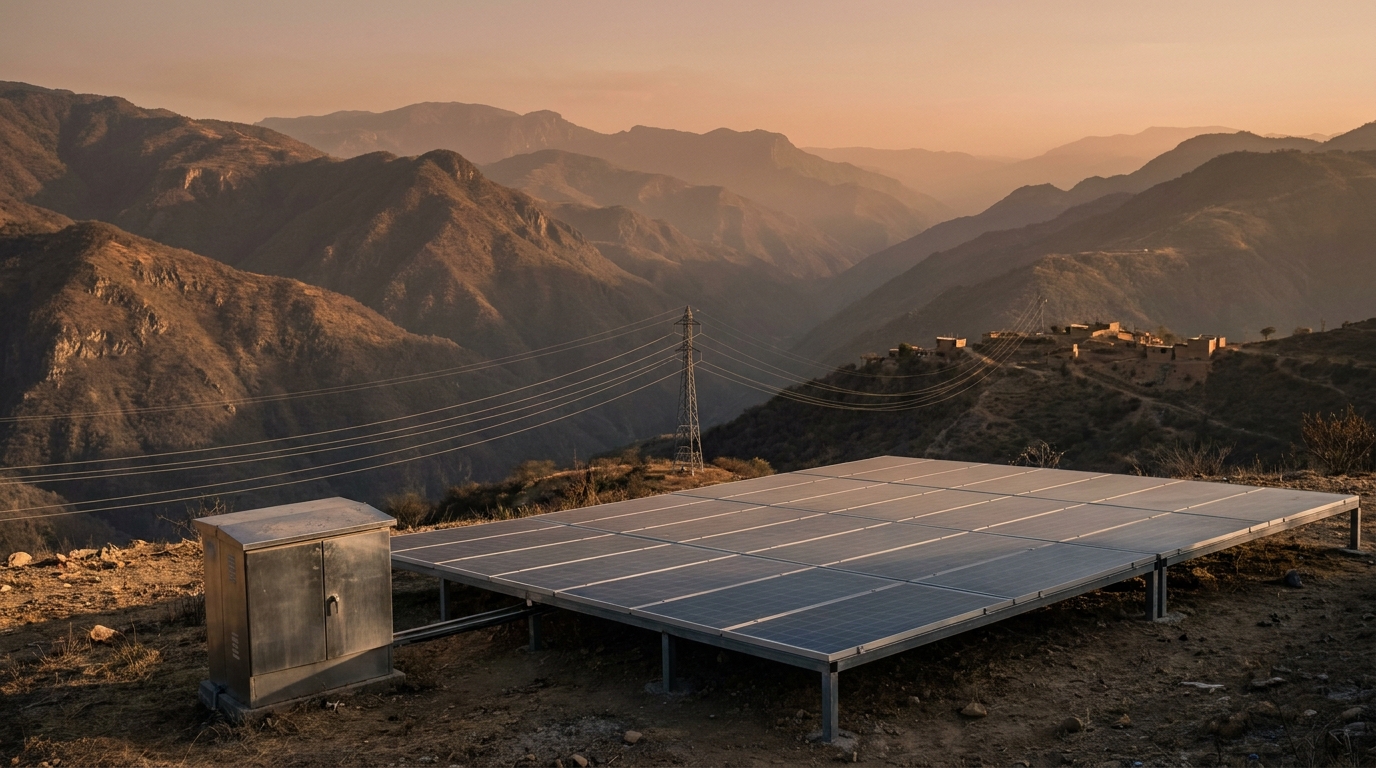
Closing the remaining 0.2 percent of Mexico's coverage gap opens a value-capture route that connects electrification, distributed generation, and storage with the 2030 industrial agenda.
On June 17, 2026, the Comisión Federal de Electricidad presented the Plan de Justicia Eléctrica 2026, with national coverage of 99.8 percent and a target of 99.9 percent by 2028, according to statements from its director general. Mexico now stands above the global average for energy access, estimated at 92 percent, placing the country in the final phase of a process many economies have yet to complete.
That remaining 0.2 percent is the last mile. It coincides with remote, indigenous, and topographically challenging communities, precisely the stretch that the International Energy Agency identifies as the most costly to cover in any system. Globally, some 730 million people still lack electricity, and universal access is achievable by 2035 with accelerated effort. Mexico reaches that final stretch with room to maneuver and an articulated official plan.
The constructive reading is that the last mile is not merely a social target. It is the point where distributed generation, storage, and microgrids capture the most value, because they replace traditional grid extension with modular assets. That same portfolio aligns with the industrial demand from nearshoring and with the system's expansion roadmap to 2030.
The Structural Opportunity: Closing the 0.2 Percent
The Plan de Justicia Eléctrica contemplates a six-year investment of approximately 27 billion pesos, with 3,237 electrification works scheduled for 2026 and 17,017 already completed under the current administration, according to CFE figures. The installed base exceeds 50 million users, so the challenge is no longer one of mass coverage but of territorial precision.
The missing connections are, for the most part, isolated locations where extending the grid is inefficient. There, the natural solution is distributed solar with battery storage, a scheme that converts a logistics problem into a market of replicable and financeable assets.
Implications: Who Captures the Value
For institutional funds, family offices, and industry chambers, the last mile configures a pipeline of small, standardizable, and volume-scalable projects. The national target of raising the share of clean energy from 22 to 38 percent by 2030, put forward by SENER, extends that horizon well beyond rural electrification.
The benefit extends to industrial corridors. A grid with full coverage and distributed generation at its margins offers greater operational resilience to manufacturing relocating to Mexico, an attribute increasingly decisive in investment decisions.
Implementation Route: Actors and Sequence
The Ley de Planeación y Transición Energética grants SENER binding planning authority, which provides certainty to investors, as permits and projects align with official medium- and long-term plans. CFE executes the electrification works, while the Ley del Sector Eléctrico more clearly regulates self-consumption, distributed generation, and storage systems, according to the sector balance.
The logical sequence runs in phases toward 2028: prioritize the most dispersed localities with standardized distributed kits, integrate storage to guarantee continuity, and enable microgrids in the southeast, where the access gap and new demand converge. Each phase admits private participation under already-regulated frameworks.
Risks and Mitigation
The main factor to watch is financial. The IEA warns that high financing costs and reduced availability of development funds are slowing the pace of new connections globally. Mitigation requires blended financing schemes that combine public, private, and multilateral capital, which reduces the cost of capital for distributed projects.
A second point is the continuity and quality of supply in newly connected areas. The answer is to design from the outset with storage and scheduled maintenance, so that the asset is born with service standards comparable to urban ones. SENER's binding planning facilitates that standardization.
Executive Summary
Mexico is 0.2 percentage points from full coverage, and that final stretch is the richest in investment opportunity of the electricity cycle. Converting the last mile into a market for distributed generation and storage aligns access equity with industrial competitiveness and the 2030 renewables target.
Toward 2026-2030, the country can close the access gap and, simultaneously, build a layer of modular assets that reinforce system resilience and nearshoring attractiveness. Electrical justice ceases to be an expenditure and becomes enabling architecture.
At Scientika we follow this route closely. Subscribe to our weekly analysis or schedule a strategic session to map the investment window in distributed electrification in Mexico.
Frequently Asked Questions
What is the Plan de Justicia Eléctrica 2026?
It is the electrification policy that the Comisión Federal de Electricidad presented on June 17, 2026, to extend service to rural, remote, and indigenous communities in Mexico. It contemplates a six-year investment of approximately 27 billion pesos and 3,237 works scheduled for 2026, with the objective of bringing national coverage from 99.8 to 99.9 percent by 2028.
What level of electricity coverage does Mexico have in 2026?
Mexico reaches electricity coverage of 99.8 percent in 2026, above the global average estimated at 92 percent, according to CFE data. The official target is to reach 99.9 percent by 2028. The remaining stretch, equivalent to 0.2 percentage points, corresponds to the most dispersed localities and those with the highest connection costs.
Why is the electricity last mile an investment opportunity?
Because the missing connections are located in isolated areas where extending the traditional grid is inefficient, making distributed solar generation with storage the natural solution. These assets are modular, standardizable, and financeable by volume, and they align with the target of raising clean energy from 22 to 38 percent by 2030 and with the industrial demand from nearshoring.
Fuentes:
- El Mañana (17 Jun 2026), Plan de Justicia Eléctrica 2026 and CFE statements: https://www.elmanana.com.mx/nacional/2026/6/17/plan-de-justicia-electrica-2026-las-comunidades-rurales-que-tendran-electricidad-este-ano-178488.html
- Global Energy (25 May 2026), SIEC 2026 and SENER targets (renewables from 22 to 38 percent by 2030): https://globalenergy.mx/noticias-especiales/columnas/siec-2026-industria-y-tecnologia-para-el-futuro-energetico-de-mexico/
- IEA, World Energy Outlook 2025, "Achieving access for all" (12 Nov 2025): https://www.iea.org/reports/world-energy-outlook-2025/achieving-access-for-all